







“I want a modern home” and “I want a contemporary home” are used like they mean the same thing constantly by homeowners, and honestly, sometimes by designers too. But they’re not interchangeable, and the mix-up usually shows up mid-project, when a client pictures warm walnut and exposed brick, and the designer’s moodboard is all sharp white and glass.
Here’s the short version before we go deeper: modern design is a fixed historical style born in the early-to-mid 1900s. Contemporary residential interior designers in Bangalore are whatever’s current right now; it has no fixed era and keeps shifting. That one distinction explains almost everything else that separates them.
Where “Modern” Actually Comes From
Modern design isn’t a vague aesthetic word; it’s a specific movement, rooted in Bauhaus and Scandinavian design philosophy from the 1920s through the 1950s. Think of Charles and Ray Eames, clean geometric furniture, and the guiding principle “form follows function,” meaning nothing exists on a piece of furniture unless it’s doing a job.
You’ll recognize a genuinely modern-style room by:
- Exposed structural materials steel, concrete, glass left visible rather than covered up
- Furniture with simple, geometric silhouettes and minimal ornamentation
- A palette built around neutrals, sometimes accented with one bold primary color
- Natural materials like teak, walnut, and leather, often left in warm, honest tones
Where “Contemporary” Actually Comes From
Contemporary design doesn’t belong to any decade it’s a moving target, always describing whatever’s stylish right now. That’s why a contemporary home in 2015 and a contemporary home in 2026 look genuinely different, even though both were “contemporary” when they were built.
Right now, contemporary interiors tend to lean toward:
- Curved, softer furniture silhouettes replacing the sharp angles of a few years ago
- Cooler, more restrained color palettes think greige, soft taupe, and muted sage
- Mixed materials—glass, matte metal, and stone paired freely rather than sticking to one material family
- Open layouts where negative space is treated as part of the design, not empty space to fill
Modern vs Contemporary: Side-by-Side
| Element | Modern Design | Contemporary Design |
| Time period | Fixed early to mid-20th century | Fluid reflects current trends only |
| Color palette | Neutral base + one bold accent | Soft, cool neutrals, muted tones |
| Materials | Steel, glass, exposed concrete | Mixed materials, frequently updated |
| Furniture shape | Geometric, angular | Curved, softer, often modular |
| Ornamentation | Minimal to none, function-first | Minimal, but layered with texture |
| Consistency | Stays true to the era’s rules | Changes every few years |
Why This Confusion Happens So Often
- Both styles reject clutter.
- Both favor clean lines and open layouts.
- Both photograph beautifully in the same kind of natural light.
On the surface, a modern living room and a contemporary living room can look almost identical to someone who isn’t looking closely, which is exactly why the terms get swapped so casually, even by people shopping for furniture or briefing a designer.
The real tell is in the details: does the space look like it was frozen in a specific design era (modern), or does it look like it could only exist right now, built from whatever’s trending this year (contemporary)?
Which One Actually Suits Your Home?
Go modern if you’re drawn to warm, honest materials, don’t mind furniture with visible structure, and want a look that stays timeless rather than needing regular refreshes.
Go contemporary if you like updating your space every few years, prefer a cooler and more minimal palette, and want your home to always feel current rather than tied to one aesthetic era.
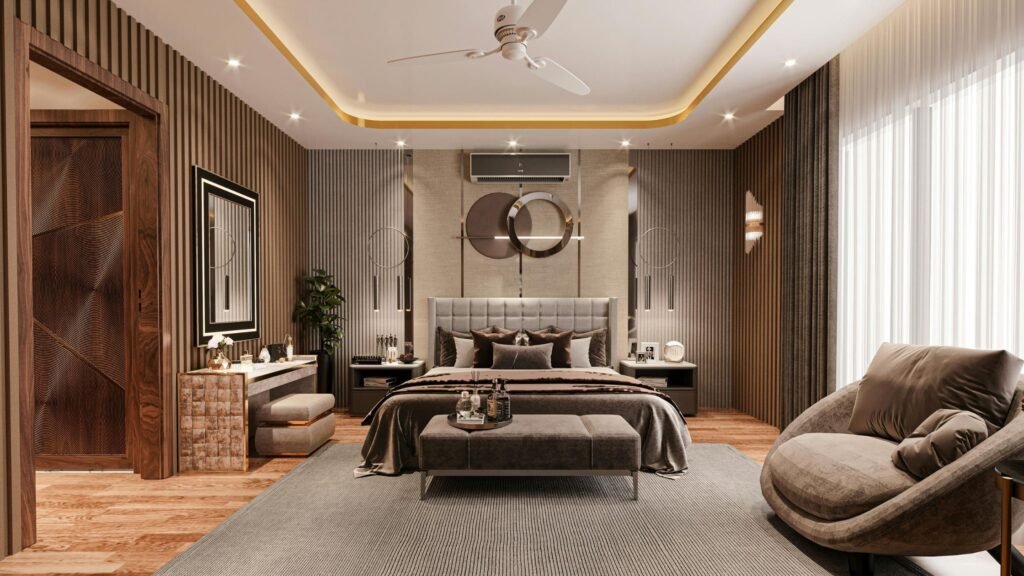
Or blend both this is more common than people think. “Contemporary modern” spaces pair a Modernist structural element, like a floor-to-ceiling glass wall, with a distinctly current piece, like a curved artisanal lamp or a boucle armchair. Neither style is precious about staying pure, and some of the best-looking homes borrow from both.
A Bangalore-Specific Note
In Bangalore, where a lot of new apartments already come with clean, minimal shells, the modern-vs-contemporary decision usually comes down to material warmth. Homeowners who want their apartment to feel less clinical often lean modern — warm wood tones, leather, visible textures. Those who want their home to feel current and are comfortable updating décor every few years tend to lean contemporary, with a lighter, more neutral base that new furniture pieces can be layered onto easily.
This is also where working with a designer who actually understands both languages helps Bhavana Interior and Decorators works across both modern and contemporary residential interiors in Bangalore, and the first real step is usually just this: figuring out which one actually matches how you want to live in the space, not just how it should look in photos.
Conclusion
Neither style is objectively better; they solve for different things. Modern gives you a warm, structural, timeless base. Contemporary gives you flexibility to stay current without a full renovation every few years. Know which trade-off you’re comfortable with, and the rest of the design decisions color, material, furniture tend to fall into place on their own.
Frequently Asked Questions
What is the main difference between modern and contemporary interior design?
Modern design refers to a fixed historical style from the early-to-mid 20th century, while contemporary design describes whatever’s currently trending, with no fixed time period, meaning it keeps evolving.
Can Modern & Contemporary Design Be Combined in One Home?
Yes. Modern and contemporary design can work beautifully together. This combination is often described as contemporary modern design. It blends the clean, structured elements of Modernist design—such as simple forms and exposed materials—with contemporary furniture, finishes, and décor.
Which is more expensive, modern or contemporary interior design?
Neither style is automatically more expensive. The overall cost depends mainly on the quality of materials, level of customization, and furniture choices. However, contemporary interiors may require more frequent updates because the style evolves with changing trends.
Is contemporary design the same as modern design?
No. Although the terms are often used interchangeably, they have different meanings. Modern design refers to a specific design movement that developed during the 20th century. Contemporary design, on the other hand, reflects what is popular and relevant today, so its look continues to evolve over time.
What furniture shapes are typical in contemporary design?
Contemporary design currently favors curved, softer furniture silhouettes and modular pieces, a shift from the sharper geometric shapes that were more common in contemporary interiors a few years ago.
How do I know if my home is modern or contemporary style?
If your home features exposed structural materials like steel or concrete with geometric furniture and warm neutral tones, it likely leans modern; if it has a cooler, ever-updating palette with mixed materials and curved furniture, it’s more contemporary.